
Research
Research
AI for Human Biology
We develop AI systems that learn across molecules, cells, tissues, and patients. Our research spans foundation models, generative AI, agentic systems, and multimodal modeling, with the long-term goal of building virtual patients for precision medicine.
Biology is one of the most demanding environments for artificial intelligence [1]. Solving it requires algorithms that can reason across scales, generalize across technologies, and predict the effects of interventions [2].
Our Vision
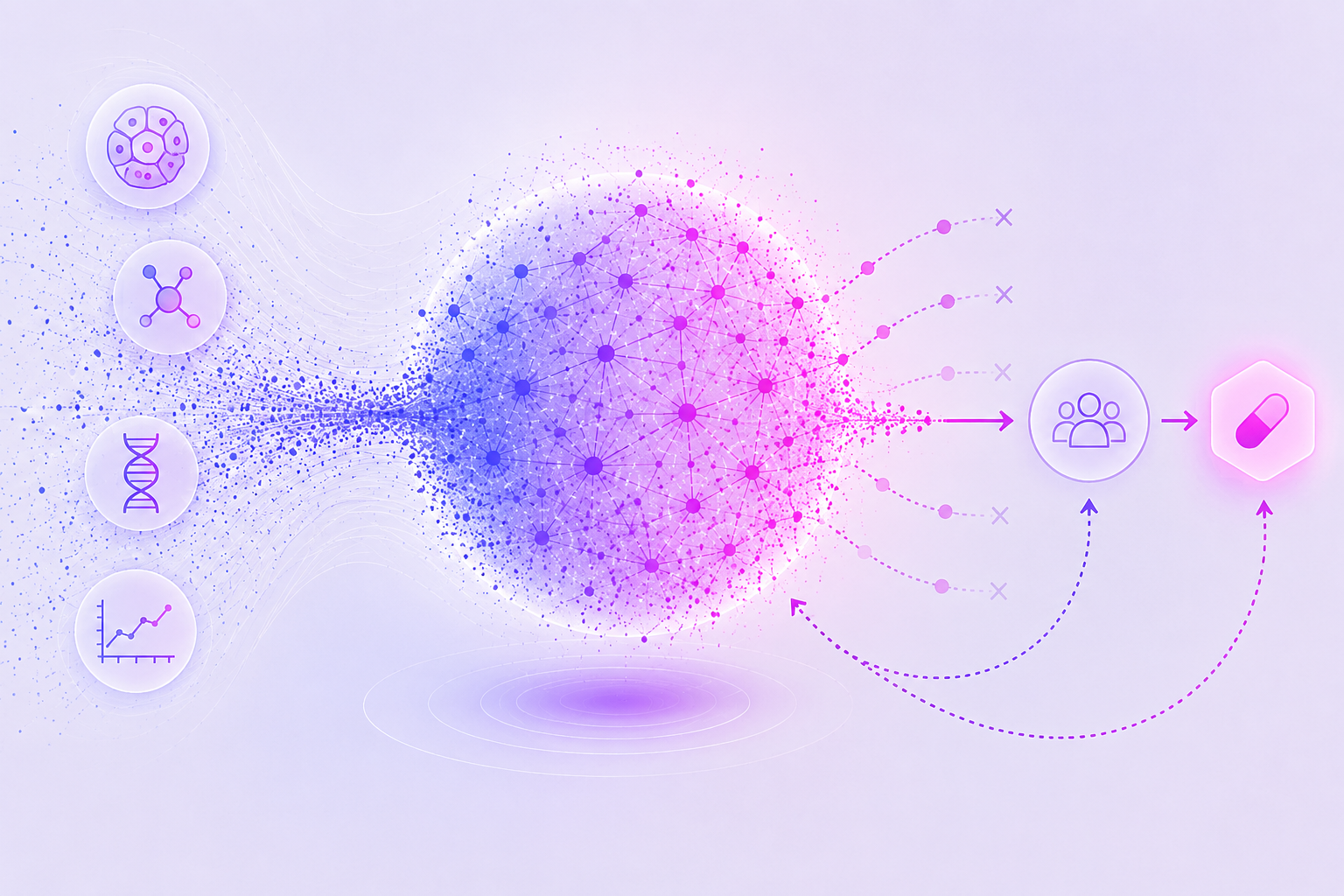
Our vision is a computational model of an individual patient that continuously integrates molecular, cellular, tissue, imaging, and clinical information. Rather than analyzing isolated measurements, virtual patients learn coherent representations of biology, simulate disease progression, and predict responses to future interventions.
Core AI Research
02
Multimodal Architectures
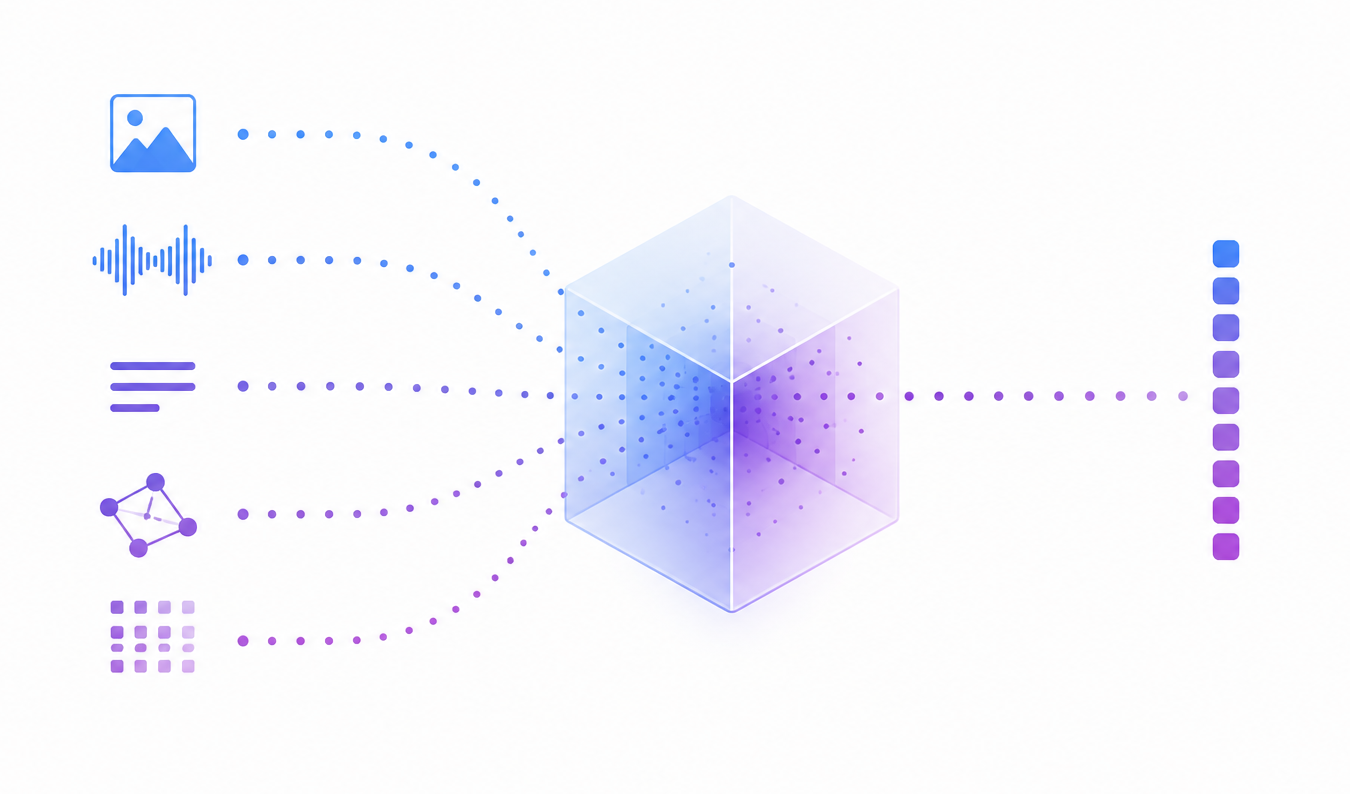
Architectures for heterogeneous data.
We design neural architectures for multimodal representation learning across images, sequences, graphs, spatial data, and clinical context, with an emphasis on scalable pretraining, alignment, and generalization.
Our Flagship Projects
01
From Virtual Cells to World Models
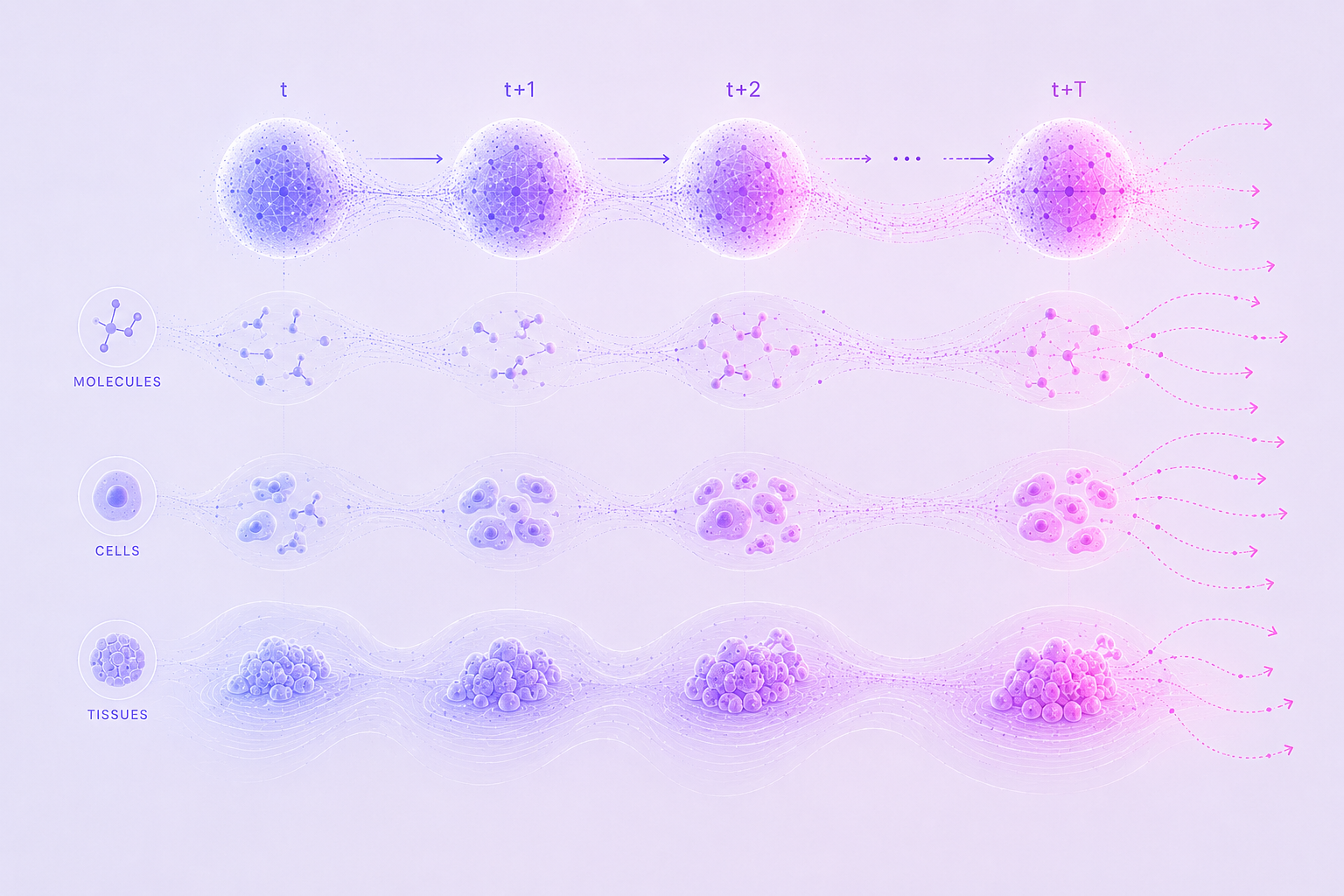
How do we build multimodal multiscale foundation models for biology [8] and enable simulation and dynamic modeling of cell function and behavior? Read about Virtual Cells and our AI 2050 Project on Biological World Models.
02
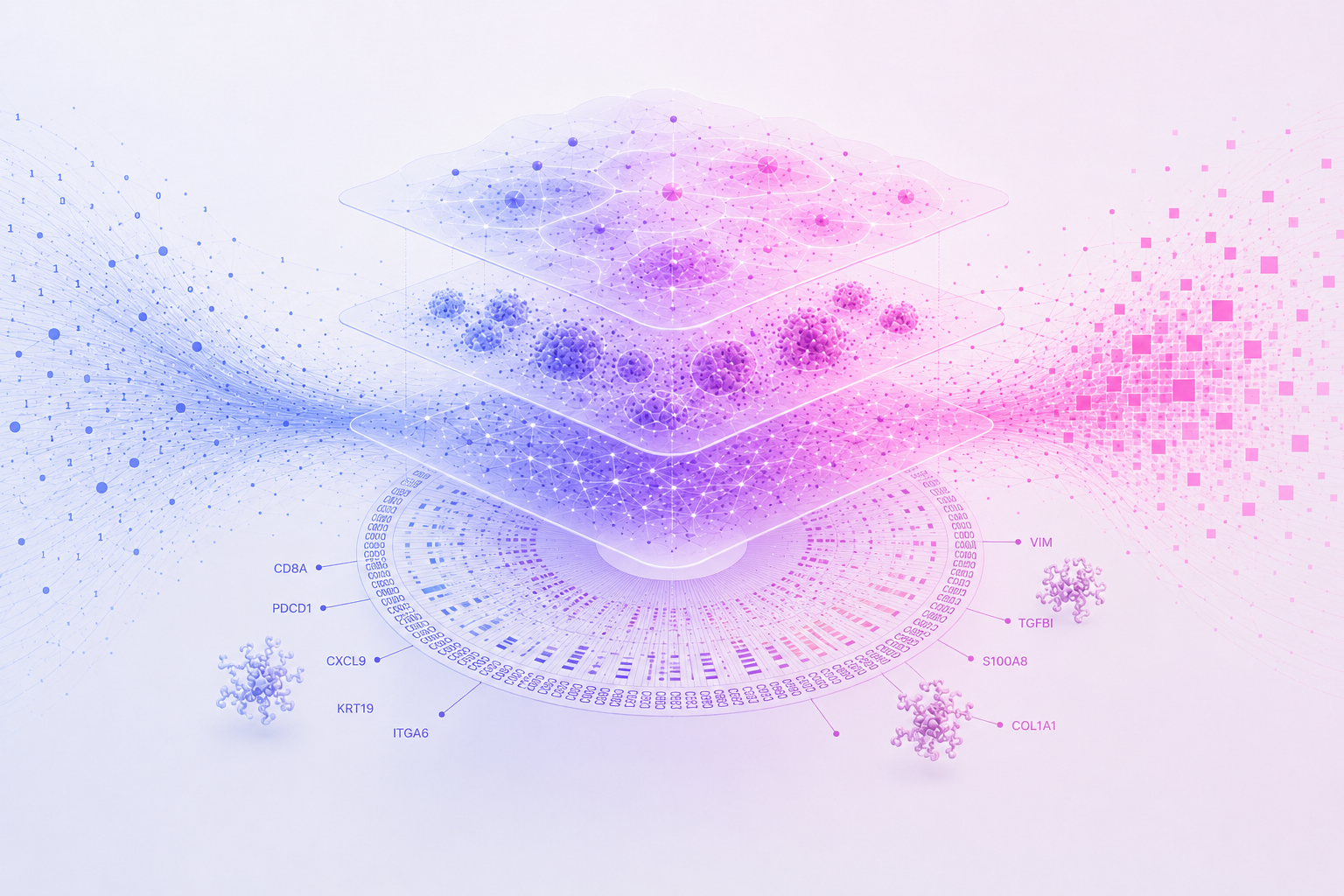
Foundation Models for Tissue Biology
The Virtual Tissues platform [9] is a novel vision foundation model for large-scale training from tissue data to facilitate atlas creation and biological discovery. Read about its novel transformer architecture and our data platform enabling large-scale learning.
Recent Highlights
On Building and Designing Foundation Models
From association to reasoning: foundation models must learn to ask “what if.” An essay on their design and building blocks.
How to Build the AI Virtual Cell
Our vision on how to build multi-scale multi-modal foundation models for biomedicine.
Tutorial on Neural OT and Diffusion Models
A tutorial on neural optimal transport to diffusion models: theory and applications.
References
- Charlotte Bunne and Aviv Regev (2026): Beyond Representation: AI in Cellular Discovery. In: Daedalus, vol. 155, no. 1-2, pp. 92–109, 2026, (Part of the Special Issue ‘AI & Science: What Is the Future of Discovery?’, alongside contributions by Demis Hassabis, Yann LeCun, Pushmeet Kohli, and others.).
- Charlotte Bunne and Yusuf Roohani and Yanay Rosen and Ankit Gupta and Xikun Zhang and Marcel Roed and Theo Alexandrov and Mohammed AlQuraishi and Patricia Brennan and Daniel B. Burkhardt and Andrea Califano and Jonah Cool and Abby F. Dernburg and Kirsty Ewing and Emily B. Fox and Matthias Haury and Amy E. Herr and Eric Horvitz and Patrick D. Hsu and Viren Jain and Gregory R. Johnson and Thomas Kalil and David R. Kelley and Shana O. Kelley and Anna Kreshuk and Tim Mitchison and Stephani Otte and Jay Shendure and Nicholas J. Sofroniew and Fabian Theis and Christina V. Theodoris and Srigokul Upadhyayula and Marc Valer and Bo Wang and Eric Xing and Serena Yeung-Levy and Marinka Zitnik and Theofanis Karaletsos and Aviv Regev and Emma Lundberg and Jure Leskovec and Stephen R. Quake (2024): How to build the virtual cell with artificial intelligence: Priorities and opportunities. In: Cell, vol. 187, iss. 25, no. 25, pp. 7045-7063, 2024.
- Johann Wenckstern and Eeshaan Jain and Benedikt Querfurth and Yexiang Cheng and Kiril Vasilev and Matteo Pariset and Phil F. Cheng and Petros Liakopoulos and Olivier Michielin and Andreas Wicki and Gabriele Gut and Charlotte Bunne (2026): The Virtual Tissues foundation model resolves spatial proteomics across scales. In: Nature, 2026, (Best Paper Award at the ICLR MLGenX Workshop, 2025).
- Eeshaan Jain and Johann Wenckstern and Benedikt Querfurth and Charlotte Bunne (2025): Test-Time View Selection for Multi-Modal Decision Making. In: International Conference on Learning Representations (ICLR) Workshop on Machine Learning for Genomics Explorations, 2025, (Contributed Talk at ICLR MLGenX Workshop, 2025).
- Martin Rohbeck and Charlotte Bunne and Edward De Brouwer and Jan-Christian Huetter and Anne Biton and Kelvin Y. Chen and Aviv Regev and Romain Lopez (2025): Modeling Complex System Dynamics with Flow Matching Across Time and Conditions. In: International Conference on Learning Representations (ICLR), 2025, (Spotlight Talk at ICLR (Top 5.2 percent). Also presented at NeurIPS Workshop on AI for New Drug Modalities, 2024).
- Vignesh Ram Somnath and Matteo Pariset and Ya-Ping Hsieh and Maria Rodriguez Martinez and Andreas Krause and Charlotte Bunne (2023): Aligned Diffusion Schrödinger Bridges. In: Conference on Uncertainty in Artificial Intelligence (UAI), 2023, (Also presented at the ICML Workshop on New Frontiers for Learning, Control, and Dynamical Systems, 2023).
- Charlotte Bunne and Ya-Ping Hsieh and Marco Cuturi and Andreas Krause (2023): The Schrödinger Bridge between Gaussian Measures has a Closed Form. In: International Conference on Artificial Intelligence and Statistics (AISTATS), 2023, (Oral Presentation at AISTATS, Top 1.9 percent of Submitted Papers. Also presented at the ICML Workshop on Continuous Time Methods for Machine Learning, 2022).
- Charlotte Bunne and Yusuf Roohani and Yanay Rosen and Ankit Gupta and Xikun Zhang and Marcel Roed and Theo Alexandrov and Mohammed AlQuraishi and Patricia Brennan and Daniel B. Burkhardt and Andrea Califano and Jonah Cool and Abby F. Dernburg and Kirsty Ewing and Emily B. Fox and Matthias Haury and Amy E. Herr and Eric Horvitz and Patrick D. Hsu and Viren Jain and Gregory R. Johnson and Thomas Kalil and David R. Kelley and Shana O. Kelley and Anna Kreshuk and Tim Mitchison and Stephani Otte and Jay Shendure and Nicholas J. Sofroniew and Fabian Theis and Christina V. Theodoris and Srigokul Upadhyayula and Marc Valer and Bo Wang and Eric Xing and Serena Yeung-Levy and Marinka Zitnik and Theofanis Karaletsos and Aviv Regev and Emma Lundberg and Jure Leskovec and Stephen R. Quake (2024): How to build the virtual cell with artificial intelligence: Priorities and opportunities. In: Cell, vol. 187, iss. 25, no. 25, pp. 7045-7063, 2024.
- Johann Wenckstern and Eeshaan Jain and Benedikt Querfurth and Yexiang Cheng and Kiril Vasilev and Matteo Pariset and Phil F. Cheng and Petros Liakopoulos and Olivier Michielin and Andreas Wicki and Gabriele Gut and Charlotte Bunne (2026): The Virtual Tissues foundation model resolves spatial proteomics across scales. In: Nature, 2026, (Best Paper Award at the ICLR MLGenX Workshop, 2025).
- Charlotte Bunne and Stefan Stark and Gabriele Gut and … and Mitchell Levesque and Kjong Van Lehmann and Lucas Pelkmans and Andreas Krause and Gunnar Rätsch (2023): Learning Single-Cell Perturbation Responses using Neural Optimal Transport. In: Nature Methods, 2023, (Highlighted as Research Briefing in Nature Methods. Also presented at the NeurIPS Workshop on Optimal Transport and Machine Learning (OTML), 2021).
- Kiril Vasilev and Alexandre Misrahi and Eeshaan Jain and Phil F Cheng and Petros Liakopoulos and Olivier Michielin and Michael Moor and Charlotte Bunne (2025): MTBBench: A Multimodal Sequential Clinical Decision-Making Benchmark in Oncology. In: Advances in Neural Information Processing Systems (NeurIPS) Datasets and Benchmarks Track, 2025.