
Selected Papers
All
Selected Papers
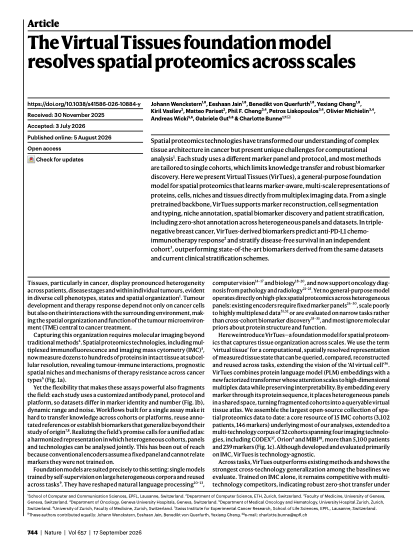
Nature, 657, 744–754 (2026)
Spatial proteomics technologies have transformed our understanding of complex tissue architecture in cancer but present unique challenges for computational analysis. Each study uses a different marker panel and protocol, and most methods are tailored to single cohorts, which limits knowledge transfer and robust biomarker discovery. Here we present Virtual Tissues (VirTues), a general-purpose foundation model for spatial proteomics that learns marker-aware, multi-scale representations of proteins, cells, niches and tissues directly from multiplex imaging data. From a single pretrained backbone, VirTues supports marker reconstruction, cell segmentation and typing, niche annotation, spatial biomarker discovery and patient stratification, including zero-shot annotation across heterogeneous panels and datasets. In triple-negative breast cancer, VirTues-derived biomarkers predict anti-PD-L1 chemo-immunotherapy response and stratify disease-free survival in an independent cohort, outperforming state-of-the-art biomarkers derived from the same datasets and current clinical stratification schemes.
Dædalus, 155:1–2, 92–109 (2026)
A new paradigm is emerging at the intersection of artificial intelligence and experimental biology, where cells are no longer merely observed, but comprehensively modeled, queried, and predicted in silico. This essay traces how advances in single-cell and spatial measurement technologies, perturbation biology, and AI foundation models are giving rise to virtual cells: integrative models that represent, simulate, and anticipate cellular behavior. By closing the loop between data generation, prediction, and hypothesis testing, AI is transforming biology into a self-refining, interactive science, with implications for precision medicine, biotechnology, and the scientific method.
Part of the Dædalus Special Issue on AI & Science: What Is the Future of Discovery? alongside contributions from Demis Hassabis, Yann LeCun, Pushmeet Kohli, and others.
Part of the Dædalus Special Issue on AI & Science: What Is the Future of Discovery? alongside contributions from Demis Hassabis, Yann LeCun, Pushmeet Kohli, and others.

Cell, 187:25 P7045-7063, (2024)
Cells are essential to understanding health and disease, yet traditional models fall short of modeling and simulating their function and behavior. Advances in AI and omics offer groundbreaking opportunities to create an AI virtual cell (AIVC), a multi-scale, multi-modal large-neural-network-based model that can represent and simulate the behavior of molecules, cells, and tissues across diverse states. This Perspective provides a vision on their design and how collaborative efforts to build AIVCs will transform biological research by allowing high-fidelity simulations, accelerating discoveries, and guiding experimental studies, offering new opportunities for understanding cellular functions and fostering interdisciplinary collaborations in open science.

Nature Reviews Methods Primers, 4:58 (2024)
High-throughput single-cell profiling provides an unprecedented ability to uncover the molecular states of millions of cells. These technologies are, however, destructive to cells and tissues, raising practical challenges when aiming to track dynamic biological processes. As the same cell cannot be observed at multiple time points, as it changes in time and space in response to a stimulus or perturbation, these large-scale measurements only produce unaligned data sets. In this Primer, we show how such challenges can be effectively addressed using the unifying framework of optimal transport theory and tackled using the many algorithms that have been proposed for the range of scenarios of key interest in computational biology. We further review recent advances integrating optimal transport and deep learning that allow forecasting heterogeneous cellular dynamics and behaviour, crucial in particular for pressing problems in personalized medicine.

Nature Methods volume 20, 1759–1768 (2023)
Understanding and predicting molecular responses in single cells upon chemical, genetic or mechanical perturbations is a core question in biology. Obtaining single-cell measurements typically requires the cells to be destroyed. This makes learning heterogeneous perturbation responses challenging as we only observe unpaired distributions of perturbed or non-perturbed cells. Here we leverage the theory of optimal transport and the recent advent of input convex neural architectures to present CellOT, a framework for learning the response of individual cells to a given perturbation by mapping these unpaired distributions. CellOT outperforms current methods at predicting single-cell drug responses, as profiled by scRNA-seq and a multiplexed protein-imaging technology. Further, we illustrate that CellOT generalizes well on unseen settings by (1) predicting the scRNA-seq responses of holdout patients with lupus exposed to interferon-β and patients with glioblastoma to panobinostat; (2) inferring lipopolysaccharide responses across different species; and (3) modeling the hematopoietic developmental trajectories of different subpopulations.
All
Loading publications…